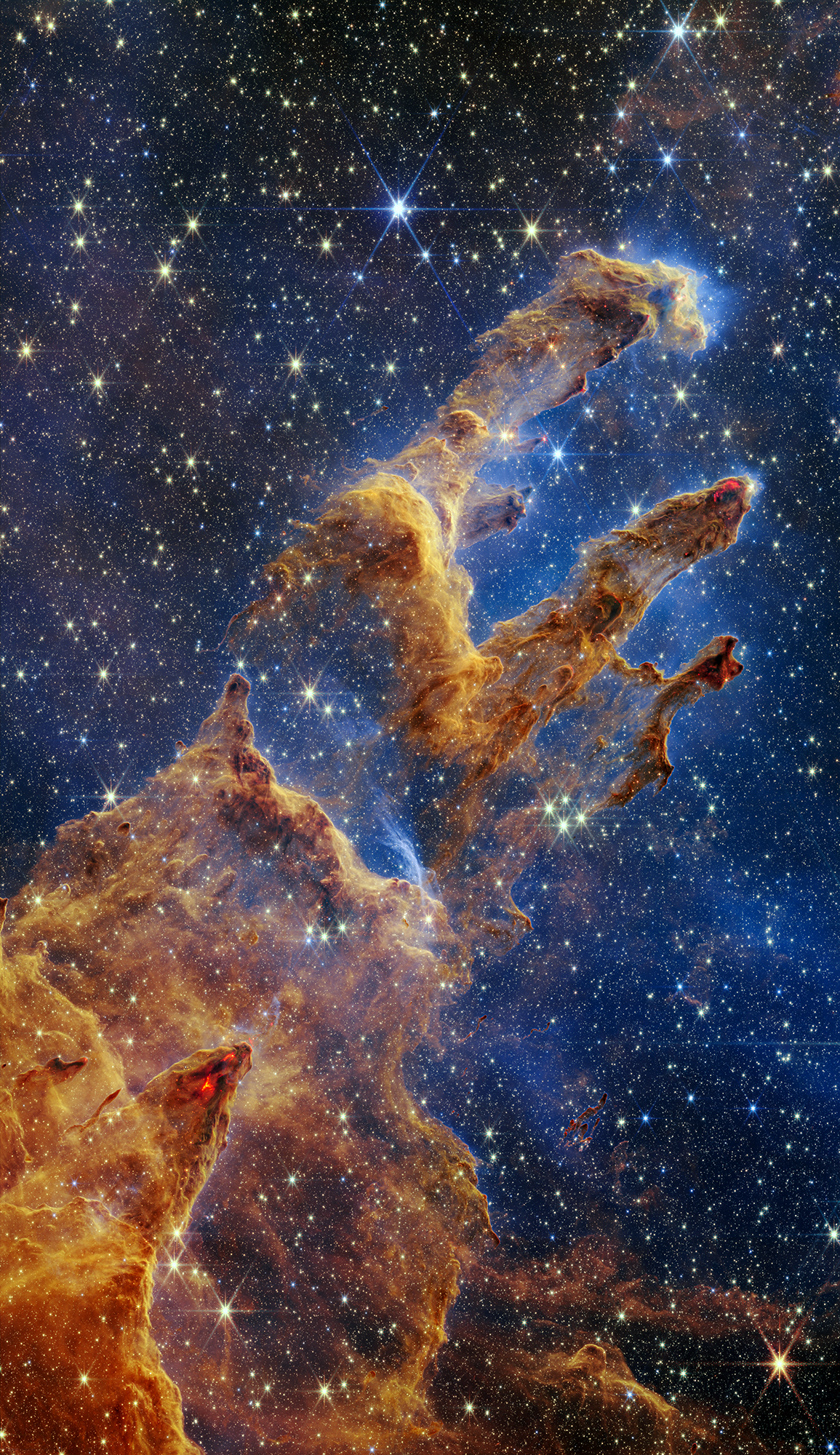
When we look at the night sky, we are basically looking into the past. The light from distant stars takes millions of years to reach our eyes, meaning the universe we see is a landscape of ghosts. In her Pulitzer Prize-winning poetry collection Life on Mars, Tracy K. Smith uses this space fact as a powerful symbol for the human mind and how we process grief. Smith served as the United States Poet Laureate in both 2017 and 2019,, and Life on Mars is her third poetry collection. Life on Mars was published shortly after the death of her father, an engineer who worked on the Hubble Space Telescope. Smith's collection contrasts the huge, cold emptiness of outer space with the fragile and sometimes failing human body. Using scientific words mixed with deep emotion, Smith argues that the universe is not just an empty space to explore, but a mirror for our own inner minds. By connecting the feeling of loss with the language of space, Life on Mars shows how people survive the scary reality of death: not by running away from it, but by learning to live around it.
Smith's look at human weakness begins by imagining a future where aging and sickness are completely gone. In"Sci-Fi," she builds a spotless vision of tomorrow, wiped clean of the painful parts of having a body. She writes:
There will be no edges, but curves.
Clean lines pointing only forward.
History, with its hard spine & dog-eared
Corners, will be replaced with nuance.
Smith uses words "clean," "curves," and "forward" to create an image of unnatural perfection. She treats "History" like a human body with a "hard spine & dog-eared / Corners," turning all of human experience into something that can get sick and break down. History does not just end in this future; it is cured, like an illness. Her use of enjambment copies the unstoppable forward push of this vision, leaving no natural place to pause, to grieve, or to look back. Yet the overall tone is ironic. By describing a perfect world where suffering and aging don't exist, Smith highlights exactly what makes life meaningful, which is our shared human weakness. Missing something requires us losing it first. A life without the threat of death, the poem suggests, is a life missing the very things that make memory and deep emotion possible.
If "Sci-Fi" imagines a future trying to escape the human body, "My God, It's Full of Stars" brings us right back to the emotional reality of living with loss. Using the language of space and wonder, Smith closes the gap between the outer universe and our inner thoughts. She writes:
Perhaps the great error is believing we're alone,
That the others have come and gone—a momentary blip—
When all along, space might be choc-full of traffic,
Smith opens with the word "error," framing human loneliness not as a feeling but as a mistake in thinking. The word "blip" is deliberately small and almost dismissive, reducing the entire existence of other beings to a barely noticeable signal. Yet the third line immediately contradicts this, insisting that space might in fact be "choc-full of traffic." This tension between emptiness and fullness is the emotional core of the poem. Just as space holds dying stars and the light of things that burned out long ago, the mind holds onto grief and memories that refuse to fade just because the person is gone. The speaker lives inside a system, both the universe and the mind, that is clearly full yet still feels completely alone. Smith refuses to easily solve this problem, choosing instead to sit with that feeling. Her father's death acts like a dying star in the poem. The physical body is gone, but its emotional gravity continues to pull and change the path of her mind. The brain, she suggests, does not let go of what it loves. It only learns, slowly and imperfectly, how to adapt to the bearing of loss.
"My God, It's Full of Stars"holds grief inside the mind as something vast and permanent, but"The Weather in Space" shows what that grief feels like in the moment it first arrives. As the opening poem of the collection, it sets the emotional tone that the rest of the book follows. Smith writes:
we go chasing
After all we're certain to lose, so alive
Faces radiant with panic.
The enjambment between "we go chasing / After all we're certain to lose"creates a falling sensation, a breathless forward movement that gives physical shape to the fear of losing someone. The final image,"Faces radiant with panic,"puts two opposite words together."Radiant"belongs to the language of stars and light, while"panic" belongs to the body in crisis. By combining them, Smith suggests that the experience of almost losing someone is, strangely, what makes us feel most alive. Like ancient starlight that still travels millions of years to reach our eyes, love only becomes fully visible at the moment it is about to disappear.
Where "The Weather in Space" locates human fragility in the panicked, feeling body, "The Good Life" brings that same fragility down further, placing it in the ordinary realities of money, hunger, and the working body. Instead of looking outward toward stars and cosmic distance, Smith turns to the daily struggles of material need, showing that human fragility is not only emotional but also physical and economic. She writes:
They speak as if it were a mysterious lover
Who went out to buy milk and never
Came back, and it makes me nostalgic
For the years I lived on coffee and bread,
Smith turns money into "a mysterious lover" who disappears without warning, giving economic insecurity the emotional shape of abandonment and making poverty feel personal and impossible to control. The detail "went out to buy milk and never / Came back" (Smith) is deliberately ordinary. Milk is one of the most basic household items, which makes the disappearance feel all the more sudden and senseless. The word "nostalgic" is also unexpected here. Rather than feeling anger or bitterness about a hard past, the speaker looks back on years of "coffee and bread" with something closer to longing, as if bare survival had its own kind of intimacy. In this way, Smith shows that human weakness is not only revealed in grief after death, but also in the everyday conditions of being alive, where the body depends on forces it cannot fully control. By placing this material struggle next to the cosmic language found elsewhere in Life on Mars, she reminds us that the biggest emotional questions are always tied to the smallest facts of survival.
In the final analysis, Life on Mars is not a book about escaping Earth. It is a deep thought on what it means to be tied down to it. Tied down to a body, to a history, to the people whose absence changes us from the inside. Through space metaphors and physical imagery, Smith connects the science of the stars with human emotion, showing they were never really separate. Poems like "Sci-Fi," "The Weather in Space," "My God, It's Full of Stars,"and"The Good Life"prove that the huge size of the universe is mirrored by the deep, scary spaces in our own minds, and that this same fragility shows up whether we are grieving a lost person or simply trying to make it to the next payday. We are human beings navigating the space of our own memories, learning to live among the ghosts of starlight. At a time when grief is often treated as something to be moved past, Smith insists that it be looked at directly, and that poetry is one of the few places where that kind of honesty is still possible. In this way, Smith's book makes the coldness of outer space feel deeply, heartbreakingly human, and by doing that, makes grief feel just a little less lonely.
Work Cited
Smith, Tracy K. Life on Mars. Graywolf Press, 10 Jan. 2017.